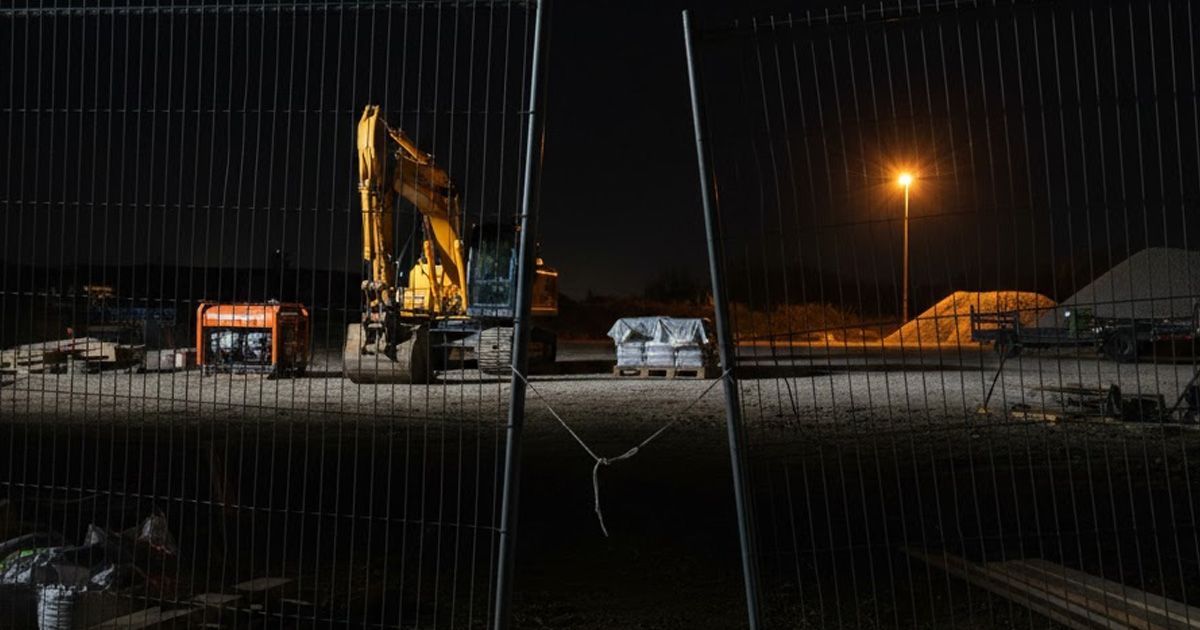
$1 billion. That's what the construction industry loses to site theft every year in the United States. Roughly 1,000 pieces of equipment are stolen every month. Insurance claims for theft-related damages exceed $200 million annually worldwide.
The frustrating part? Most of it is preventable. Construction site theft follows predictable patterns. Thieves look for the same vulnerabilities, strike during the same windows, and target the same materials. And general contractors, even experienced ones, make the same mistakes that create those openings.
Here are the five most common — and how to close the gaps before they cost you.
Mistake #1: Weak Perimeter Security
The perimeter is your first line of defense. When it has gaps, your entire security setup suffers, because a thief who gets through the fence doesn't worry about the cameras inside it.
The common failure: Fencing with openings, unsecured gates, or solid barriers that create blind spots. Thieves study sites before they act — they identify which gate is easiest to breach, where the fence line has a gap, where materials are stacked close enough to the fence to climb over. They often prepare their exit route during the day, under the guise of being a vendor or worker.
Solid timber gates and fencing at entry points create visual blind spots that conceal activity from cameras positioned inside the perimeter. Corners and fence intersections are notorious dead zones where camera coverage overlaps poorly.
The fix:
- Minimum 8–10 foot chain-link fencing around the full perimeter
- Transparent (chain-link) fencing and gates at all entry points — eliminate the visual blind spots that solid barriers create
- Limit entry points aggressively — every gate is a potential vulnerability
- Electronic access or keyed locks on all entry points
- Regular perimeter inspections: look for fence damage, tampering, or materials stacked near the fence line
- Position cameras specifically to cover corner blind spots and gate entry zones
The larger and more complex the site, the more critical this becomes. Large sites have more potential entry points, and each one is an invitation if it isn't secured and monitored.
Mistake #2: Ignoring the Lighting Problem
Construction sites go dark at night. That's when 70%+ of site theft occurs.
The common failure: Adequate lighting during work hours, darkness during the hours that matter most. Thieves overwhelmingly prefer to work in low-light conditions — it reduces visibility, limits witnesses, and signals that nobody's watching. 80% of construction site theft incidents occur between 10 PM and 4 AM. Theft spikes on weekends and holidays. A dark site at 11 PM on a Saturday is broadcasting availability.
The fix:
- Portable lighting units in high-risk areas: equipment storage, material stockpiles, primary entry points
- Motion-activated floodlights at entry points — the sudden illumination disrupts and deters
- Night-vision cameras (IR illuminators) to maintain visual coverage when ambient lighting is limited
- Visible signage at entry points: "Site Under 24/7 Video Surveillance"
Lighting alone won't stop a determined thief. But it eliminates the darkness that makes construction sites attractive to opportunistic theft — which accounts for a significant portion of incidents. Bright, well-lit sites with visible cameras and signage get passed over in favor of easier targets.
Mistake #3: Treating Recording as Security
This is the most expensive mistake on this list, because it feels like security while providing almost none of it.
The common failure: Installing cameras that record activity without any live monitoring or response capability. The cameras are there. The footage exists. The theft happens anyway — and you find out when the crew arrives the next morning.
The recovery rate for stolen construction equipment is less than 7%. Once your generator, your copper wire, or your skid steer leaves the site, you're probably filing a police report and an insurance claim, not getting it back.
Here's the sequence that plays out when you rely on passive recording: Thief enters site. Camera records. Thief loads equipment. Camera records. Thief leaves. Camera records. You arrive the next morning. You review the footage. You call police. Police file a report. Insurance adjusters visit. You wait. Seven percent of the time, something is recovered.
The fix:
Upgrade to active monitoring. When a camera detects activity, a live operator reviews it in real time, verifies whether it's a genuine threat, and responds:
- Live audio warning through the camera speaker: "You are on a monitored construction site. Leave immediately."
- Immediate alert to the site manager
- Law enforcement escalation with verified video evidence of an active incident
The difference between active and passive security isn't a feature upgrade — it's the difference between deterrence and documentation. Active monitoring stops theft. Passive monitoring records it.
Mistake #4: Ignoring Insider Threats
The most uncomfortable statistic in construction security: 30–85% of jobsite theft is committed by people with authorized site access.
Employees. Subcontractors. Temporary workers. Delivery drivers. People who know where your high-value equipment is stored, when the site is unoccupied, and how to move materials without raising alarms. Insider theft often goes unnoticed longer than external theft precisely because trusted individuals raise less suspicion.
The common failure: Focusing exclusively on external threats — cameras at the perimeter, locks on the gates — while leaving the interior of the site open to the people who work in it. No inventory tracking. No tool accountability. No vetting process for subcontractors and temporary workers.
The fix:
- Background checks for all employees, subcontractors, temporary workers, and frequent vendors
- Inventory tracking: formal daily check-in/check-out for tools and equipment. Discrepancies get noticed immediately, not after the project ends
- Camera placement inside the site: equipment storage areas, tool rooms, and high-value material stockpiles should have coverage, not just the perimeter
- Mark tools permanently: permanent identifiers (engraving, UV marking) reduce resale value and deter employee theft
- Locked storage for portable tools at end of every shift — don't rely on honor systems
- Toolbox talks: regular conversations with your crew about security expectations and the cost of theft to the project and the team
Culture matters here. A crew that understands why security procedures exist and takes ownership of site safety is harder to steal from than one that sees security as management's problem.
Mistake #5: Leaving High-Value Materials and Equipment Unsecured
The most stolen items on construction sites are the ones with the highest resale value and the easiest path to conversion: copper, lumber, hand tools, power tools, generators, welders, and other portable equipment.
The common failure: Leaving valuable materials visible and accessible overnight. Heavy equipment left unlocked. Copper and lumber stacked in plain sight near the perimeter. Portable tools left in unlocked trailers or piled in open storage areas. No GPS tracking on equipment worth tens of thousands of dollars.
Organized theft rings target construction sites specifically because of this pattern. Copper theft alone has increased 29% over the past five years. One successful overnight theft can delay a project, trigger an insurance claim, and push your timeline by weeks.
The fix:
- Lock all portable tools in storage containers, sheds, or trailers at the end of every shift — no exceptions
- Chain and lock heavy equipment when not in use: use manufacturer-provided locking mechanisms and additional chains where possible
- GPS tracking on high-value equipment — it won't prevent theft, but it gives you a realistic chance at recovery (well above the base 7% rate)
- Store materials out of sight where possible: inside structures under construction, behind fencing, away from the perimeter
- Daily inventory checks: spot discrepancies the same day they happen, not when the job is wrapping up
- Increase security posture during high-risk windows: add surveillance, lighting, and monitoring during three-day weekends, holiday periods, and phase transitions
The goal is to make your site a harder target than the alternatives. Organized theft rings in particular will move on to easier opportunities when a site demonstrates robust controls.
The Pattern Behind the Mistakes
Look at these five mistakes together and a pattern emerges: construction site security failures are predictable. Weak perimeters. Dark sites. Passive cameras. No insider controls. Unsecured materials. These are the gaps thieves look for because these are the gaps they consistently find.
Addressing them isn't complicated. It requires a security posture that's built into your project planning — not assembled after the first incident.
Active monitoring, solar-powered cameras that deploy before your materials arrive, daily inventory protocols, proper perimeter security, and lighting in the right places eliminate most of what makes construction sites easy targets.
The $1 billion that leaves the industry every year isn't random. It flows through the same gaps. Close the gaps.
Related reading:
- How Construction Managers Are Losing $1B+ to Jobsite Theft—And How to Stop It
- Active Monitoring vs. Motion-Only Cameras: What Actually Stops Theft
Start with a free site security consultation — before your next project's materials arrive.
Get a custom quote in under 24 hours. No obligation, no long-term contracts.